Which Ecommerce Platform Is Best for SEO?

In the competitive world of eCommerce, having a visually appealing store isn’t enough—your website must also be easily discoverable by search engines. This is where eCommerce SEO (Search Engine Optimization) comes into play. SEO helps online stores rank higher in Google search results, driving organic traffic and increasing sales. Unlike paid ads, which stop generating traffic once the budget runs out, a well-optimised website attracts visitors long-term. However, achieving strong SEO performance depends on your strategy and the eCommerce platform you choose.
Key takeaways
- There is no single best ecommerce platform for SEO; the right one depends on your size, budget and technical skills.
- WooCommerce gives the most SEO control and the best blogging; Shopify is easiest and fast, but forces /products/ and /collections/ in URLs.
- Magento (Adobe Commerce) suits large stores with developers; BigCommerce suits mid-sized stores; Wix suits small, simple stores.
- Check any platform for speed, mobile design, HTTPS, editable URLs and meta tags, redirects, schema and XML sitemaps.
- Your content, product pages and links still decide rankings; the platform only sets how easy the work is.
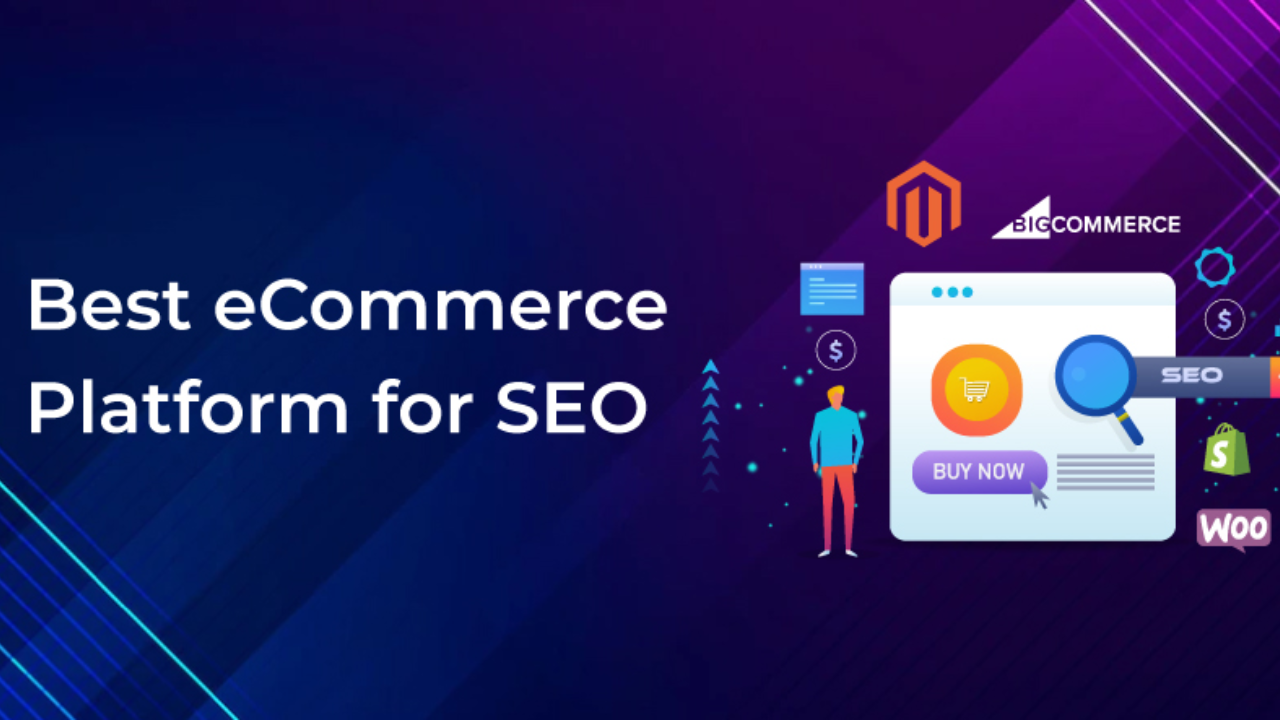
Different eCommerce platforms offer varying levels of SEO control, affecting key factors like page speed, mobile responsiveness, URL structure, metadata customisation, and content management. Platforms with built-in SEO tools make optimisation easier, while others may require additional plugins or technical expertise to optimise fully. Choosing the right platform ensures your store meets Google’s ranking criteria, improves user experience, and reduces reliance on paid marketing efforts. A poorly optimised platform, on the other hand, can limit your ability to rank well, no matter how strong your SEO strategy is.
When selecting an SEO-friendly eCommerce platform, businesses should consider key factors such as fast loading speed, mobile-friendly design, secure HTTPS support, customisable URLs, and strong blogging capabilities. These elements help search engines understand and rank your website effectively. With so many platforms available, deciding on the best one can be overwhelming.
Key SEO Factors for eCommerce Platforms
When selecting an e-commerce platform, it’s essential to consider the SEO capabilities that will directly impact your store’s visibility and rankings. Search engines like Google prioritise websites that offer a seamless user experience, fast performance, and well-structured content. Below are the key SEO factors determining how well an e-commerce platform can help your store rank in search results.
Site Speed & Performance
Website speed is a critical ranking factor. Faster-loading websites enhance user experience, reduce bounce, and increase conversion rates. Google’s Core Web Vitals measure loading (LCP), responsiveness (INP) and visual stability (CLS), and slow pages lose shoppers before they buy. The best eCommerce platforms offer optimised code, caching mechanisms, and content delivery networks (CDNs) to improve load times.
Mobile-Friendliness & Responsiveness
 With most shoppers browsing and purchasing via mobile phones, Google now prioritises mobile-first indexing. An SEO-friendly eCommerce platform must have a responsive design, meaning the site automatically adjusts to different screen sizes for a smooth experience. Platforms with mobile-optimized themes and templates ensure that product pages, checkout processes, and navigation remain user-friendly on smartphones and tablets.
SEO-Friendly URL Structures & Customisation
A clean and structured URL helps search engines understand a page’s content. Platforms that allow users to customise URLs, add keywords, and remove unnecessary parameters (e.g., “?id=123”) are more SEO-friendly. Short, descriptive URLs like “example.com/best-running-shoes” perform better than long, unreadable ones. Control over permalinks, redirects, and canonical tags is essential for good SEO.
Built-in SEO Features & Plugins
Some eCommerce platforms provide built-in SEO tools, while others require external plugins to optimise for search engines. Essential features include customisable meta titles, descriptions, alt text for images, schema markup, and automatic XML sitemaps. Platforms with SEO-focused plugins (e.g., Yoast SEO for WooCommerce) offer additional capabilities like keyword optimization and technical SEO improvements.
Content Marketing & Blogging Capabilities
 SEO isn’t just about optimising product pages; content marketing is major in organic traffic growth. Platforms with blogging features allow businesses to create valuable content, such as how-to guides, product comparisons, and industry trends, which help attract visitors through search engines. A built-in blog with SEO-friendly formatting, tagging, and internal linking improves authority and search rankings over time.
Security & HTTPS Support
Security is another crucial SEO factor. Google favours HTTPS-encrypted websites because they provide a secure browsing experience. An eCommerce platform should support SSL certificates, protecting sensitive customer data (like payment details). Platforms with built-in firewalls, two-factor authentication, and security updates help maintain site integrity and protect rankings from potential penalties due to security vulnerabilities.
Top eCommerce Platforms for SEO
Shopify – Best for Ease of Use and Speed
 Shopify is one of the most popular eCommerce platforms, known for its user-friendly interface and fast performance. It has built-in SEO features, including customisable meta tags, alt text for images, and automatic sitemaps. Shopify stores are hosted on high-speed servers, ensuring quick load times, a crucial SEO ranking factor.
However, Shopify’s biggest SEO drawback is its rigid URL structure. The platform automatically adds /collections/ and /products/ to URLs, limiting full customisation. Despite this, it remains a solid option for small to mid-sized businesses looking for a balance of SEO and usability.
💡 Best For: Small to medium-sized businesses wanting easy setup and fast-loading pages.
WooCommerce – Best for Full SEO Control
 Built on WordPress, WooCommerce is the most flexible and SEO-friendly eCommerce platform. Since WordPress is known for powerful blogging and content marketing, WooCommerce benefits from its robust SEO plugins like Yoast SEO, which allow advanced on-page optimization.
WooCommerce gives users full control over URL structure, metadata, and technical SEO, making it an excellent choice for businesses prioritising content marketing and organic growth. However, because it requires self-hosting, businesses must manage site speed and security, which can be challenging for beginners.
💡 Best For: Businesses prioritising content marketing and wanting full SEO control.
Magento (Adobe Commerce) – Best for Large Enterprises
 Magento is a powerful, open-source eCommerce platform designed for large-scale businesses. It provides advanced technical SEO capabilities, including customisable URLs, metadata, schema markup, and multi-store functionality. Magento also supports progressive web apps (PWAs), which enhance mobile SEO and user experience.
While Magento offers extensive customisation options, it requires technical expertise to manage. Without proper optimisation, Magento stores can become slow and resource-intensive, negatively affecting SEO. However, it is one of the most powerful SEO platforms for enterprises with development resources.
💡 Best For: Large businesses and enterprises looking for scalability and advanced SEO control.
BigCommerce – Best for Mid-Sized Businesses
 BigCommerce is an excellent SEO-friendly platform with customisable URLs, fast-loading templates, and built-in SEO tools. Unlike Shopify, BigCommerce allows full control over URL structures, making creating clean and optimised links easier.
BigCommerce also supports AMP (Accelerated Mobile Pages), although Google no longer gives AMP pages any ranking advantage, so a fast responsive theme matters more. The platform’s only downside is its limited blogging functionality, which may require integration with WordPress for content marketing.
💡 Best For: Mid-sized businesses needing SEO flexibility without advanced coding skills.
Wix eCommerce – Best for Beginners with Small Stores
 Wix eCommerce is an easy-to-use, drag-and-drop platform that offers built-in SEO tools such as structured data, automatic sitemaps, and mobile optimisation. Wix simplifies on-page SEO for small businesses with automatic meta tag generation and alt-text suggestions.
However, Wix is not ideal for scaling because it offers limited advanced SEO options, such as full URL customization and technical SEO enhancements. However, it remains a decent choice for small businesses with basic SEO needs.
💡 Best For: Small businesses or beginners looking for simple SEO tools without technical complexity.
SEO Pros and Cons of Each Platform
| Platform | SEO Pros | SEO Cons |
| Shopify | ✅ Easy to use, ideal for beginners
✅ Fast-loading pages for better rankings ✅ Mobile-friendly themes and automatic HTTPS ✅ Built-in SEO tools for metadata, redirects, and sitemaps |
❌ Limited URL customization (e.g., forced /collections/ in URLs)
❌ Requires third-party apps for advanced SEO features ❌ Blog functionality is basic compared to WordPress |
| WooCommerce | ✅ Full SEO control with customizable URLs and permalinks
✅ Extensive SEO plugins like Yoast SEO for optimization ✅ Ideal for content marketing with WordPress blog integration ✅ Great flexibility for on-page and technical SEO |
❌ Requires manual optimization and technical knowledge
❌ Can slow down if too many plugins are installed ❌ Self-hosted, so speed and security depend on hosting provider |
| Magento (Adobe Commerce) | ✅ Advanced technical SEO features (schema markup, SEO-friendly URLs)
✅ Scalable for large businesses and enterprises ✅ Supports progressive web apps (PWAs) for mobile SEO ✅ Multi-store functionality for international SEO |
❌ Steep learning curve, requires development expertise
❌ Heavy platform, may require dedicated hosting for performance ❌ Expensive to maintain and develop |
| BigCommerce | ✅ Built-in SEO features (custom URLs, metadata, redirects)
✅ Faster load times with optimized themes ✅ Supports AMP (Accelerated Mobile Pages), though AMP no longer gives a ranking boost ✅ No transaction fees, unlike Shopify |
❌ Limited blogging features, requiring WordPress integration for content marketing
❌ Fewer free themes compared to Shopify ❌ Learning curve slightly higher than Shopify |
| Wix eCommerce | ✅ Beginner-friendly with simple drag-and-drop interface
✅ Automatic SEO setup, including structured data ✅ Mobile optimization and automatic sitemaps ✅ SSL certificate included for security |
❌ Limited SEO customization compared to WooCommerce and Magento
❌ Not ideal for scaling larger eCommerce businesses ❌ Fewer advanced SEO tools and integrations |
Best Choice Based on Business Needs
Choosing the right eCommerce platform depends on your business size, technical expertise, and SEO goals. While each platform offers unique SEO features, some are better suited for specific types of businesses. Below, we list the best SEO-friendly eCommerce platforms based on different business needs.
Best for Beginners & Small Businesses: Shopify
Shopify is the best choice for entrepreneurs and small business owners looking for an easy-to-use platform with built-in SEO features. It offers fast page speeds, mobile-friendly themes, and essential SEO tools without requiring technical expertise. While it lacks full URL customisation, Shopify is great for businesses that want a quick and scalable setup with minimal effort.
💡 Ideal for: Small business owners, startups, and first-time eCommerce sellers.
Best for Advanced SEO & Content Marketing: WooCommerce
If your business relies on content marketing, blogging, and full SEO control, WooCommerce is the best option. Built on WordPress, it provides powerful SEO plugins like Yoast SEO, allowing deep customisation of URLs, metadata, and technical SEO. Since Google values high-quality content, WooCommerce is perfect for businesses focused on organic traffic growth through blogging and SEO strategies.
💡 Ideal for: Content-driven businesses, bloggers, and companies prioritising SEO.
Best for Large Enterprises & Customization: Magento
Magento (Adobe Commerce) is the best choice for large businesses needing advanced SEO customisation and scalability. It offers technical SEO features, multi-store functionality, and progressive web apps (PWAs) for improved performance. However, Magento requires technical expertise, making it ideal for businesses with dedicated development teams.
💡 Ideal for: Large enterprises, international brands, and businesses with complex SEO needs.
Best for Mid-Sized Businesses Seeking Simplicity: BigCommerce
BigCommerce is perfect for businesses looking for an easy-to-use platform with strong SEO capabilities. It provides customisable URLs and built-in SEO tools while maintaining a user-friendly interface. Unlike Shopify, BigCommerce allows full SEO control without relying on third-party apps.
💡 Ideal for: Mid-sized businesses that want SEO flexibility without coding expertise.
Best for Drag-and-Drop Simplicity: Wix eCommerce
For businesses that prioritise ease of use over advanced SEO customisation, Wix eCommerce is a solid choice. It offers automatic SEO setup, structured data, and mobile optimisation. While Wix lacks advanced SEO flexibility, it’s a great option for businesses that want a simple, visually appealing store without dealing with technical SEO.
💡 Ideal for: Small business owners who prefer a no-code, drag-and-drop solution.
How to Switch Ecommerce Platforms Without Losing SEO
Many stores outgrow their first platform. A move from Wix to Shopify, or Shopify to WooCommerce, can keep your rankings if you plan it carefully. Most traffic losses after a migration come from broken URLs, not the new platform.
- Crawl the old site first. Export every URL, title, meta description and image with a crawler, and note your top pages by organic traffic in Google Search Console.
- Map old URLs to new URLs. Build a spreadsheet that matches each old product, category and blog URL to its new address. Platforms such as Shopify change URL folders, so few URLs will stay the same.
- Set up 301 redirects. Redirect each old URL to its closest new match, not everything to the homepage.
- Move the SEO content, not just products. Carry over titles, descriptions, product copy, alt text, reviews and structured data.
- Test before launch. Check the new site on a staging URL that is blocked from indexing, then remove that block at launch.
- Monitor after launch. Submit the new sitemap in Search Console, watch the Pages report for 404s, and keep redirects in place permanently.
Expect some ranking movement for a few weeks after a migration. Large, lasting drops usually point to missing redirects or lost content.
Frequently asked questions
Is Shopify good for SEO?
Yes, Shopify is good for SEO for most small and mid-sized stores. It includes fast hosting, HTTPS, automatic sitemaps, editable titles and meta descriptions, and a redirect manager. Its main limits are fixed URL folders such as /products/ and /collections/, and a basic blog. Apps can fill most gaps, but each one can add weight to page speed.
Is WooCommerce better than Shopify for SEO?
WooCommerce gives more SEO control: you can change URL structure, edit robots.txt freely and use plugins such as Yoast or Rank Math. Shopify is easier and handles hosting and speed for you. If you have the skills or a developer and rely on content marketing, WooCommerce has the edge. If you want low maintenance, Shopify is often the safer choice.
Does my ecommerce platform affect Google rankings?
Google does not rank a site higher because it uses a certain platform. The platform matters because it affects speed, URL structure, duplicate content, structured data and how easily you can fix technical issues. A well-optimised store on any major platform can rank; a neglected one will struggle on all of them.
Is Wix good for ecommerce SEO?
Wix is fine for small stores with a modest product range. It covers the basics well: editable meta tags, structured data, sitemaps, HTTPS and mobile layouts. It gives less control than WooCommerce or Magento and can be harder to scale or migrate away from, so it is less suited to large or fast-growing catalogues.