
Keyword Overload? Here’s How Many You Actually Need

Are you stuffing your blogs with keywords hoping to rank higher on Google? You’re not alone—and you’re not helping your SEO either. Keyword overload, once a common tactic in the early days of SEO, has become a significant warning sign in today’s content landscape. Overusing keywords can make your writing sound robotic, turn off readers, and even trigger penalties from search engines.
Key takeaways
- Target one primary keyword per page, supported by 3-5 secondary keywords plus natural variations and long-tail phrases.
- A rough 1-2% density is a sanity check, not a target; Google rewards natural, helpful writing, not repetition.
- Place the primary keyword in the title tag, H1, URL, intro and meta description, and variations in subheadings.
- Avoid stuffing and keyword cannibalisation: give each page its own focus keyword and write first, optimise second.
The truth is that adding more keywords doesn’t always lead to better results. It could be hurting your visibility and credibility. If you’re unsure how many keywords are too many—or how to place them strategically, this guide is for you.
What Is Keyword Overload?

Keyword overload occurs when a piece of content is overloaded with too many keywords, particularly when the same ones are repeated excessively. Instead of improving search rankings, this practice can make your content look spammy and unreadable.
Search engines like Google are smarter than ever. They can easily detect when keywords are being stuffed unnaturally into content. When that happens, your page may drop in rankings or fail to appear at all. Keyword stuffing goes against modern SEO guidelines, which prioritise helpful, readable content created for humans, not bots.
Here’s a quick comparison:
❌ Overloaded Example:
“If you want SEO tips, our SEO tips blog shares the best SEO tips for people who want SEO tips.”
✅ Optimised Example:
“Looking to improve your search visibility? Our latest blog covers practical SEO strategies you can apply today.”
The difference is clear. One chases rankings. The other earns them.
How Many Keywords Are Enough?

There’s no magic number, but most SEO experts agree on a safe zone: keep your keyword density between 1% and 2%. That means for every 100 words, your target keyword should appear no more than once or twice.
Here’s a quick reference based on content length:
- 500 words: 5–10 keyword uses
- 1000 words: 10–20 keyword uses
- 1500 words: 15–30 keyword uses
But don’t obsess over hitting a perfect percentage. What matters more is keyword relevance and natural placement. This is where many get confused between keyword mentions (the number of times a word is used) and keyword density (the frequency at which it appears relative to the total word count).
Google no longer rewards repetitive keyword stuffing. Instead, its algorithms now favour helpful, human-first content that flows naturally and answers user intent. If your content sounds forced, you’re doing it wrong—even if your keyword density is technically “okay.” So, rather than counting keywords, focus on clarity, relevance, and usefulness. That’s the real formula for SEO success.
Different Types of Keywords to Use
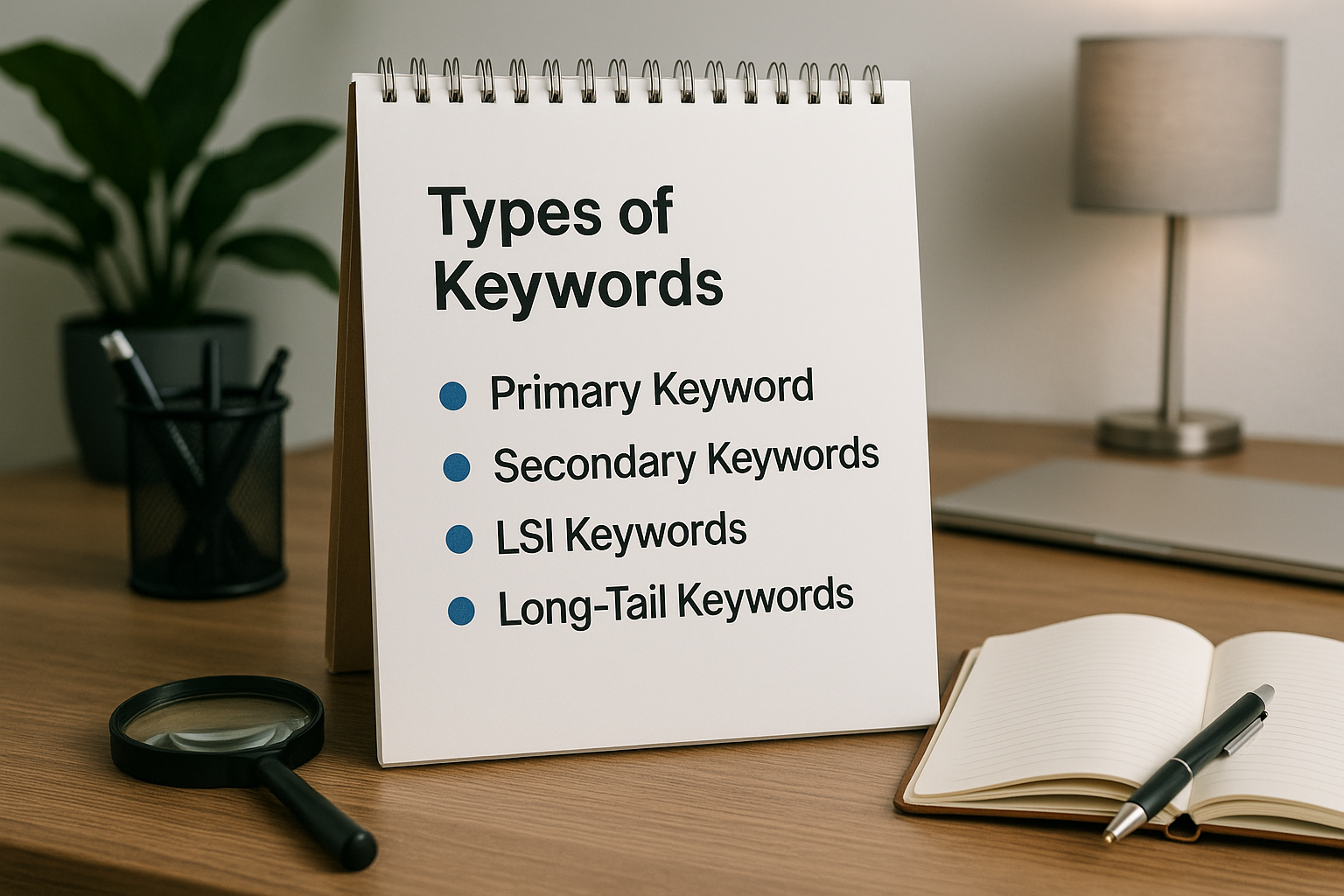
Not all keywords are created equal, and using a smart mix can significantly improve your SEO performance without overloading your content.
🔹 Primary Keyword:
This is your main focus. It reflects the core topic of your post. For example, in this blog, the primary keyword might be “keyword density” or “how many keywords to use.” It should appear in your title, intro, meta description, and naturally throughout the content.
🔹 Secondary Keywords:
These are closely related terms that support your primary keyword. They help expand your topic coverage and capture additional searches. Examples include SEO strategy, keyword optimisation, or content writing tips.
🔹 LSI (Latent Semantic Indexing) Keywords:
These are semantically related phrases that add depth and relevance. They’re not synonyms, but words commonly associated with your topic, like search engines, Google ranking, algorithm update, etc. Using LSI keywords improves context and readability.
🔹 Long-Tail Keywords:
These are more specific keyword phrases (usually three or more words) that target niche queries, such as best keyword density for blogs or how to avoid keyword stuffing. They tend to have lower competition and higher conversion rates.
📊 How to Balance Them in One Post:
- 1 Primary Keyword (used thoughtfully in key places)
- 3–5 Secondary Keywords spread across sections
- Multiple LSI and Long-Tail Keywords are embedded naturally throughout
Think of keywords as seasoning—too little and it’s bland; too much and it’s overpowering. The right mix makes your content both readable and rankable.
Where to Place Keywords for Best Impact
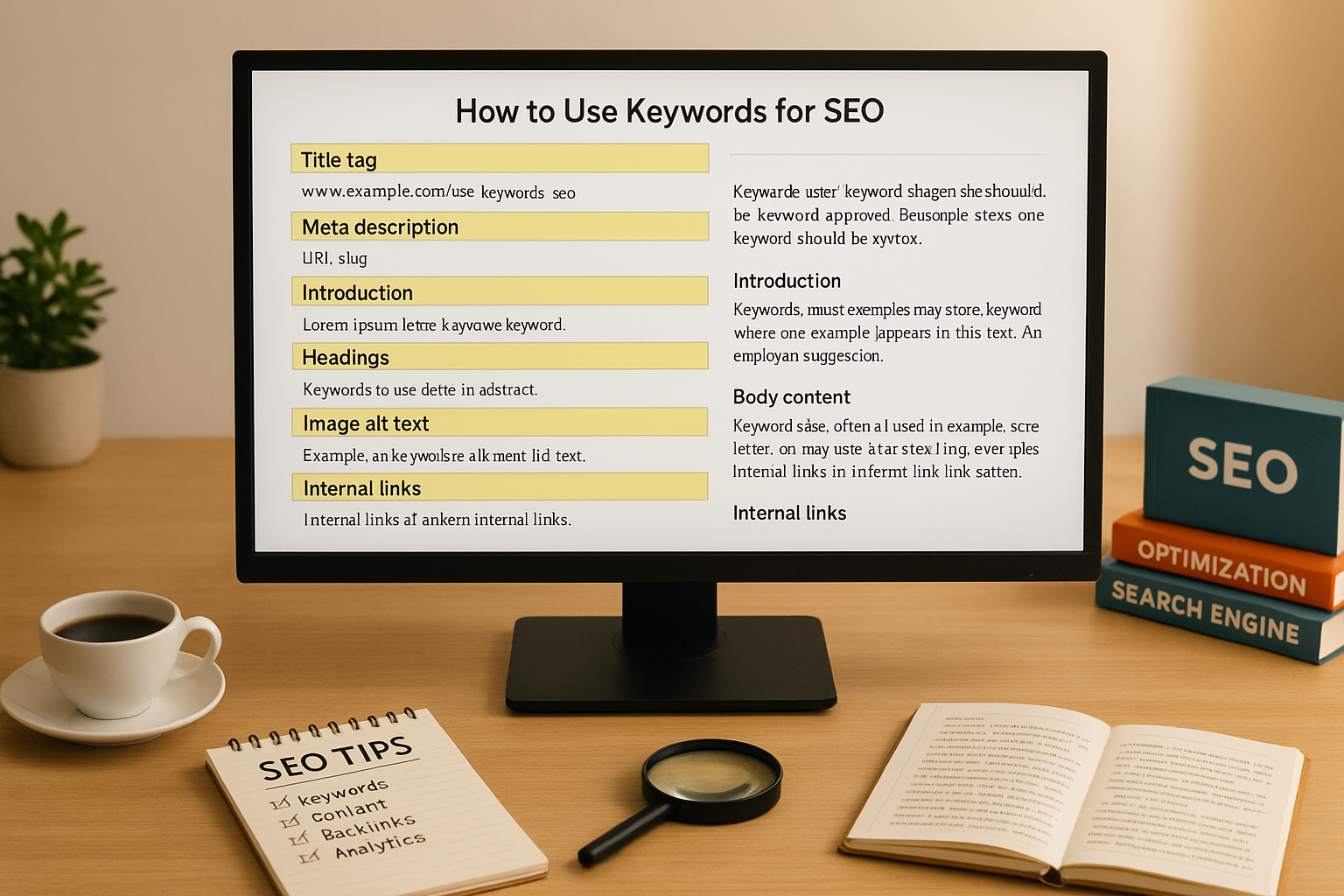
Strategic keyword placement matters just as much as how many times you use them. When you position keywords correctly, you help both search engines and readers understand the value of your content.
Here’s where to put them for maximum SEO impact:
🔹 Title Tag and Meta Description
Your primary keyword should always appear in the page title and meta description. This helps Google understand what your page is about—and boosts click-through rates in search results.
🔹 H1 and Subheadings (H2/H3)
Headings include your main keyword in the H1 (the main heading of your post) and variations in H2s and H3s. This creates a clear structure that signals the relevance of the topic to search engines.
🔹 Introduction and Conclusion
Place your primary keyword naturally in the opening paragraph and reinforce it in the closing section. These spots get the most reader attention and confirm the topic early.
🔹 Image Alt Tags
Every image should have a descriptive alt tag. Including a relevant keyword here can help with image search visibility and accessibility.
🔹 URL and Internal Anchor Text
Keep URLs clean and include the focus keyword if possible (e.g., /how-many-keywords-is-enough). Also, when linking internally to related articles, use keywords as anchor text to reinforce connections between content.
🔹 Use of Bold/Italic for Emphasis
Occasionally, highlighting keywords in bold or italics can draw attention and show importance—just don’t overdo it.
Tools to Help You Track Keyword Usage

You don’t have to guess whether you’re using the right number of keywords or placing them correctly. With the right tools, you can plan, optimise, and refine your keyword strategy with confidence.
Keyword Research Tools
These tools help you discover which keywords to target based on volume, difficulty, and search intent:
- Ahrefs – Uncover keyword opportunities and track your site’s ranking.
- SEMrush – Comprehensive research tool with keyword gaps and competitor insights.
- Ubersuggest – A budget-friendly option for basic keyword suggestions and volume trends.
On-Page Optimisation Tools
These check your content in real-time and offer SEO suggestions as you write:
- Yoast SEO – A WordPress plugin that checks keyword use, readability, and more.
- SurferSEO – Helps optimise your content structure and keyword density by comparing top-ranking pages.
- RankMath – An all-in-one SEO plugin with keyword focus analysis and schema support.
Keyword Density Checkers
Use free or paid tools like SEO Review Tools, Small SEO Tools, or Prepostseo to calculate keyword frequency and ensure you’re within the safe range (1–2%).
🤖 AI-Assisted Content Editors
- Grammarly – While primarily focused on grammar, it also helps maintain a natural tone and avoids repetitive phrasing.
- Jasper (formerly Jarvis) – AI content generator that supports SEO-driven outlines and keyword placement guidance.
With these tools in your arsenal, you can stop guessing and start optimising with clarity and control.
Common Keyword Optimisation Mistakes
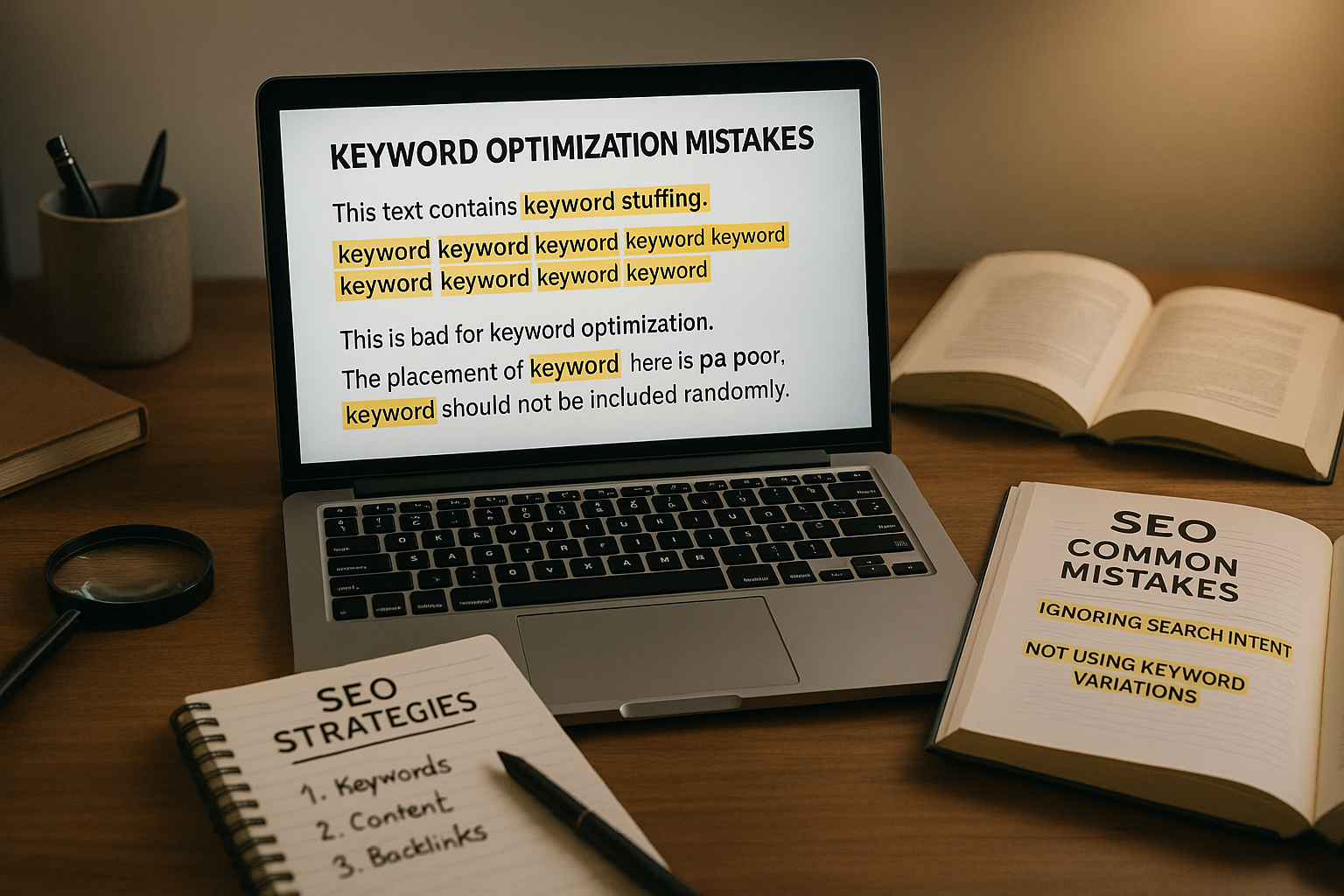
Even with good intentions, it’s easy to fall into traps that hurt rather than help your content’s performance. Here are some of the most common keyword-related mistakes—and how to avoid them:
🚫 Keyword Cannibalisation
Using the same primary keyword across multiple pages on your site can confuse search engines. Instead of boosting one page’s authority, you end up competing with yourself. Assign unique focus keywords to each page or post.
🚫 Overuse in Every Paragraph
Repeating your keyword in every block of text doesn’t make your content more relevant—it makes it unreadable. This is a classic example of keyword stuffing, which can lead to penalties or a high bounce rate. Focus on flow and readability.
🚫 Ignoring Synonyms or Natural Phrasing
Search engines understand variations in language. Relying too heavily on a single rigid phrase can miss opportunities to rank for related terms. Utilise synonyms, LSI keywords, and a conversational tone to craft more natural and helpful content.
🚫 Optimising Without Considering Search Intent
It’s not just what users search for—it’s why they search. Writing a post with perfect keyword placement won’t rank if it doesn’t match what the user wants. Ensure your content addresses the underlying question behind the query.
Pro Tips to Avoid Keyword Overload
Mastering keyword usage isn’t about cramming in as many as possible—it’s about blending them smoothly into content that helps your reader. Here are some practical tips to keep your SEO sharp without overloading:
📝 Write Naturally, Revise Later
Start by writing your content freely, focusing on clarity and flow. Once your draft is complete, revisit it with your keyword strategy in mind. This keeps the writing organic while still allowing for optimisation.
🔄 Use Synonyms and Related Phrases
Instead of repeating the same keyword, mix in synonyms and LSI keywords to diversify your content. Tools like Thesaurus.com, Google’s “related searches,” or even AI writing assistants can help expand your vocabulary without losing meaning.
🎯 Optimise for User Intent
Consider what your audience truly wants to learn or achieve. Are they looking for information, a solution, or to make a purchase? Let that intent guide your keyword use and content structure, not just the search bots.
♻️ Update Old Posts
Revisit existing blog posts and swap out repetitive keywords with more diverse variations. This keeps your content fresh and allows you to rank for additional search queries without having to rewrite from scratch.
💡 Focus on Value, Not Volume
Ultimately, keyword success stems from providing value. Well-researched, insightful, and user-friendly content naturally performs better than anything overloaded with keywords.
How to Spot and Fix Keyword Cannibalisation
Keyword cannibalisation happens when two or more of your pages target the same search and Google cannot decide which to rank. Often neither ranks as well as one combined page would.
How to find it
- Google Search Console: open Performance, filter by a query, then click the Pages tab. If several URLs get impressions for the same query and their positions keep swapping, you likely have cannibalisation.
- A site search: search
site:yourdomain.com "keyword"to see which of your pages Google associates with the term. - Your own content list: keep a simple sheet with one row per page and its focus keyword. Duplicate focus keywords stand out quickly.
How to fix it
| Situation | Fix |
|---|---|
| Two thin posts on the same topic | Merge them into one stronger page and 301 redirect the weaker URL to it. |
| Two pages with genuinely different purposes | Change the focus keyword, title and H1 of one page so each targets a different intent. |
| Near-duplicate pages you must keep | Add a canonical tag on the duplicate pointing to the main version. |
| Blog post outranking your service page | Link from the post to the service page with descriptive anchor text and reduce the post's focus on the commercial term. |
After making changes, update internal links so they point to the page you want to rank, then watch the query in Search Console for a few weeks.
Conclusion
In the world of SEO, less is often more, especially when it comes to keyword usage. Instead of overloading your content with repetitive phrases, focus on clear, helpful, and intent-driven content that serves your audience. A well-balanced keyword strategy supports your rankings and keeps readers engaged. If you’re unsure whether your past content is helping or hurting your SEO, audit it now, starting with your most important pages.
Frequently asked questions
Does Google use keyword density as a ranking factor?
No. Google has said for years that there is no ideal keyword density and that repeating a word does not make a page more relevant. It uses language understanding to work out what a page is about, including synonyms and related terms. Density is only useful as a quick check that you have not repeated a phrase so often that the text reads unnaturally.
Can one page rank for many keywords?
Yes. A strong page usually ranks for dozens or hundreds of related queries, not just its focus keyword. This happens when the page covers the topic thoroughly and answers the related questions people ask. You do not need to insert every variation word for word; covering the subtopics well is what earns those extra rankings.
What is keyword stuffing according to Google?
Google's spam policies describe keyword stuffing as filling a page with keywords or numbers to manipulate rankings. Examples include lists of phrases with no real content, blocks of city names a page is trying to rank for, and repeating the same words so often that the text sounds unnatural. Pages that do this can be demoted or removed from results.
Should I use the exact-match keyword or a natural variation?
Use the exact phrase where it reads naturally, especially in the title tag and H1, because that is how people search. In the body, mix in natural variations, plurals and synonyms. If an exact-match phrase is grammatically awkward, such as "plumber Lahore cheap", write it the way a person would say it; Google understands the connection.