SEO Tools Like Rapid URL Indexer: Indexing Alternatives Compared
Speed matters when you publish a new page or earn a new backlink: nothing can rank until Google has crawled and indexed it. Rapid URL Indexer became popular because it promises to shorten that wait for a few cents per URL. This guide looks at what it and its alternatives actually do, which options are free and official, and why most "not indexed" problems are not discovery problems at all. Everything here reflects what we could verify as of October 2026; indexing services change their prices and methods often, so confirm details on the vendor's own site before you pay.
Key takeaways
- No indexing tool can force Google to index a page; it can only prompt a crawl, and Google still decides.
- Use the free official channels first: Search Console URL Inspection and sitemaps for your own site, IndexNow for Bing, Yandex, Naver, Seznam and Yep.
- Google's Indexing API is documented only for job postings and livestreams; using it for ordinary pages breaks its terms.
- Rapid URL Indexer is a credit-based, pay-per-URL service with automatic refunds for URLs not indexed within 14 days, an API and a WordPress plugin.
- Check the Pages report in Search Console first: 'Crawled – currently not indexed' is a quality verdict that no indexer changes.
First, What an Indexing Tool Can and Cannot Do
Every indexing service, paid or free, does one thing: it tries to get a crawler to visit a URL sooner. None of them can make Google index a page. Google decides that on its own, based on whether the page is reachable, not a duplicate of something it already has, and worth storing. A tool that says it "guarantees" indexing is really saying it refunds you when Google declines; read the small print.
There are three honest ways a service can prompt a crawl:
- Official submission channels: Google Search Console's URL Inspection tool and sitemaps, the IndexNow protocol for Bing and others, and Google's Indexing API for the two content types it is meant for.
- Links from pages that are crawled often: the service places your URL on pages Googlebot visits regularly, so the crawler discovers it by following the link. This is how most paid indexers work.
- Misusing the Indexing API: some tools push ordinary URLs through Google's Indexing API, which Google's documentation reserves for job postings and livestream pages. It can work for a while, but it breaks the API's terms, and the spam policies apply to anything submitted through it.
Ask any provider which of these it uses. A vendor that will not say is the first one to drop.
The Free, Official Options
Google Search Console: URL Inspection and Sitemaps
Google Search Console is the only tool that talks to Google directly, and it is free. Paste a URL into the URL Inspection box, click Test live URL to confirm the page is crawlable, then Request indexing. The request goes into a priority crawl queue; new pages on established sites are often crawled within hours, though indexing is still not guaranteed. There is a daily quota per property, which is why people look for bulk alternatives.
For volume, use sitemaps. Submit your XML sitemap under Sitemaps (WordPress with Yoast or Rank Math generates one for you), and keep the lastmod dates honest: Google has said it uses them to decide what to recrawl. Check your file with the free marketers.pk Sitemap Validator before submitting.
Search Console only works for sites you have verified, so it does nothing for a backlink on someone else's site. That gap is where the paid indexers live.
IndexNow: instant notification for Bing, Yandex and others
IndexNow is an open protocol that lets a site tell participating search engines the moment a URL is added, changed or removed. One ping reaches all of them. As of October 2026 the participants are Microsoft Bing, Yandex, Naver, Seznam and Yep; Bing's index also feeds DuckDuckGo and ChatGPT's web search. Google tested IndexNow in 2021 but does not use it.
Turning it on takes a minute:
- Rank Math: General Settings → Instant Indexing, tick the post types to submit automatically.
- Yoast SEO: IndexNow is enabled by default in Yoast SEO Premium.
- All in One SEO: Search Appearance → Advanced → IndexNow.
- Cloudflare: Caching → Configuration → Crawler Hints, which sends IndexNow pings for any site behind Cloudflare, whatever the CMS.
- Any site: generate a key at indexnow.org, host it as a text file in your site root, and call the API with your URL list.
It will not get you into Google, but if Bing traffic or AI assistants that use Bing's index matter to you, it is free and immediate.
Google's Indexing API: only for jobs and livestreams
Google's Indexing API lets a site push URLs straight to Google, but the documentation limits it to pages with JobPosting structured data or BroadcastEvent embedded in a VideoObject. Google states that its spam policies apply to anything submitted and that using multiple accounts to dodge the quota is not allowed. Several WordPress plugins and indexing services use the API for ordinary pages anyway. It has worked for many people, and Google has not announced broad enforcement, but it is outside the terms, and a successful API response only confirms that Google received the notification, not that it indexed the URL. If you run a job board or stream live events, use it; otherwise treat it as a risk you are choosing, not a free upgrade.
Why Your Page Is Not Indexed (and What Actually Fixes It)
Before paying anyone, open Pages under Indexing in Search Console. The reason Google gives tells you whether an indexing tool can help at all. Most of the time it cannot, because the problem is not discovery.
| Search Console status | What it means | Would an indexer help? | What fixes it |
|---|---|---|---|
| Discovered – currently not indexed | Google knows the URL but has not crawled it yet, often because the site has many low-value URLs or a slow server | Sometimes | Add internal links from strong pages, remove junk URLs from the sitemap, fix server speed, request indexing for the important ones |
| Crawled – currently not indexed | Google fetched the page and chose not to keep it; usually a quality or duplication judgement | No | Improve or merge the content, add unique value, consolidate near-duplicates with redirects or canonicals |
| Duplicate without user-selected canonical | Google found another version it prefers | No | Set a canonical tag on the version you want and link to it consistently |
| Excluded by noindex tag | Your page tells Google not to index it | No | Remove the noindex tag (check your SEO plugin settings) |
| Blocked by robots.txt | Google is not allowed to crawl it | No | Edit robots.txt; test with the robots.txt Tester |
| Not found (404) / Soft 404 | The page is missing or looks empty | No | Fix the URL, restore the content, or let it stay out of the index |
| Page with redirect | The URL redirects elsewhere | No | Normal; make sure the destination is indexed. Check chains with the Redirect Checker |
Only the first row is a discovery problem, and even there the long-term fix is internal linking and a cleaner site. If your important pages sit under "Crawled – currently not indexed", no amount of submission will change Google's mind; the page needs to be better or different. To confirm a URL's status on any site, including a backlink, use the marketers.pk Google Index Checker.
Rapid URL Indexer: What It Actually Is
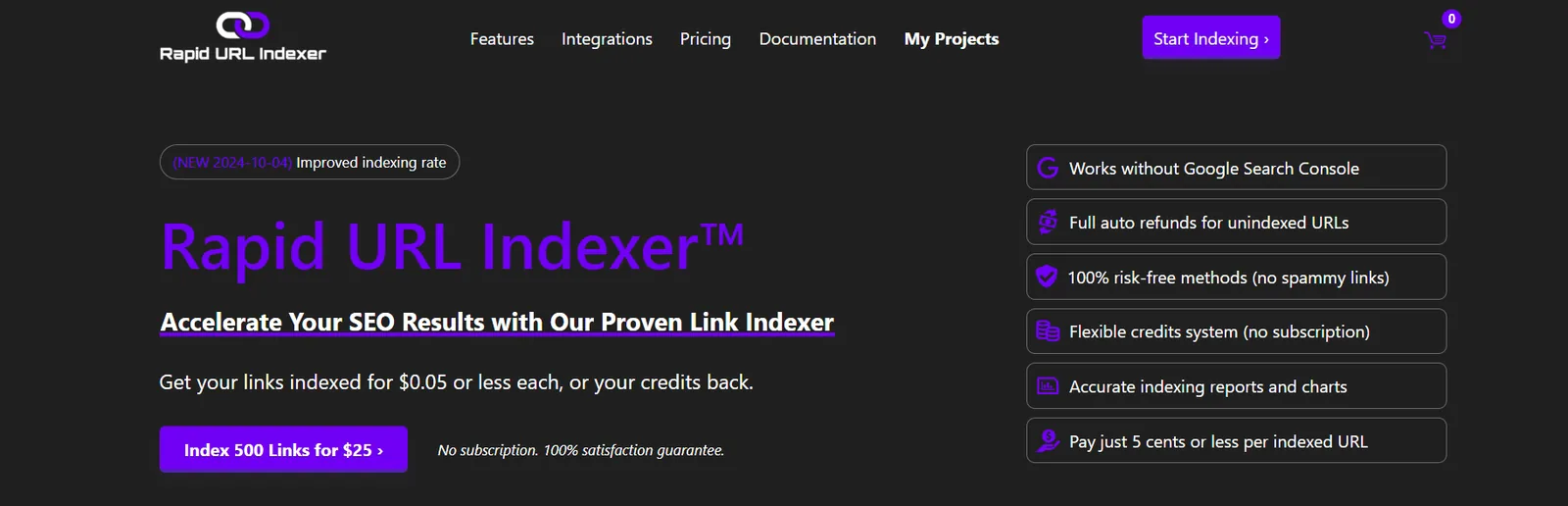
Rapid URL Indexer is a pay-per-URL service with no subscription. You buy credits, submit URLs in bulk (paste, CSV upload, API, a WordPress plugin that submits new and updated posts automatically, or a Chrome extension), and the service tracks each URL's index status in a project dashboard. Its selling points, as described on its own site:
- Credits, not a monthly fee: the homepage has advertised 500 URLs for USD 25 (five cents each), with lower per-URL prices on larger packs. Check the current pricing page before buying.
- Automatic refunds: credits for any URL that is still not indexed after 14 days are returned automatically. This is the feature that separates it from "submit and forget" indexers, because it means the vendor is measuring the outcome.
- Works without Search Console: useful for backlinks on sites you do not own.
- A free index checker for seeing which of your URLs Google has indexed before you spend credits.
- No spammy links, according to the vendor; the service says it does not build link pyramids or fake social signals to your URLs.
The vendor does not publish exactly how it prompts the crawl. Its own case studies report indexing rates well below 100 percent for low-quality pages such as press-release copies, which is consistent with Google deciding on quality after the crawl. In plain terms: it is a reasonable way to get Google to look at a large batch of URLs, with the refund limiting your downside, and it does nothing for a page Google has already seen and rejected.
Alternatives to Rapid URL Indexer
The services below have been around for years and still appear in 2026 comparisons. We have not tested them for this update, so the descriptions are limited to the models they advertise. Verify pricing, refund terms and method on each site, and run the small test described further down before buying volume.
| Service | Pricing model | Refund if not indexed | API / plugin | Best suited to |
|---|---|---|---|---|
| Rapid URL Indexer | Credits per URL, no subscription | Yes, automatic after 14 days | API, WordPress plugin, Chrome extension | Bulk backlinks and new pages, when you want to pay only for results |
| IndexMeNow | Per-URL credits, higher price per URL | Check current terms on its site | API | A small number of high-value URLs where you want a premium service |
| OneHourIndexing | Monthly subscription with a daily URL allowance | No per-URL refund | API | Agencies submitting a steady stream of links every day |
| Instant Link Indexer | Monthly subscription tiers | No per-URL refund | API | Teams that want a dashboard and recurring submissions |
| Google Search Console | Free | Not applicable | None for requesting indexing in bulk | Your own site's important pages, one at a time |
| IndexNow (via Rank Math, Yoast, AIOSEO or Cloudflare) | Free | Not applicable | Built into the plugins and Cloudflare | Instant notification to Bing, Yandex, Naver, Seznam and Yep |
Two kinds of service did not make the table, on purpose:
- "Submit to Google without an account" forms. Google removed its public URL submission page in 2018. Any site that still offers to submit your URL to Google with no account is either pinging dead endpoints or doing something it will not explain.
- Indexers that sell "social signals" or tiered link pyramids. Pointing automated links and fake social shares at your URLs is the kind of link spam that attracts manual actions. Your backlink does not need help like that; if it is on a page Google never crawls, the link was not worth much to begin with.
Who Should Use a Paid Indexer
A paid indexer makes sense in a narrow set of cases:
- You build or buy backlinks on sites you do not control, and a meaningful share of them sit uncrawled for weeks.
- You publish large batches of genuinely useful pages, such as a product catalogue or a directory, faster than Search Console's quota allows.
- You are migrating a site and want the new URLs discovered quickly after the redirects go live.
It makes no sense if your pages are being crawled and rejected, if you are trying to prop up thin or duplicate content, or if you are a small Lahore business with twenty pages; for you, a verified Search Console property, a clean sitemap and good internal linking do the whole job for free.
How to Choose and Test an Indexing Tool
Most indexers promise speed and high success rates. Few explain how they measure it. Before you commit, check these points:
- Refund or credit policy: does the tool credit back URLs that are not indexed after a set period? This suggests it measures results rather than just submissions.
- How it checks indexing: ask how status is verified. A report that only says "submitted" or "pinged" tells you nothing about Google's index.
- How it prompts the crawl: links from frequently crawled pages are fine; misuse of the Indexing API is a risk you should know you are taking; spammy pages, fake social signals or link networks pointing at your URLs can do more harm than good.
- Fit with your workflow: API access, WordPress plugins or bulk upload matter more when you handle many sites.
A fair test: pick 20 to 50 URLs that are not indexed yet and are worth indexing. Split them between two tools, and keep a few back as a control group with no submission. Check them after a week and again after two weeks with the Google Index Checker. Compare the share indexed in each group. If the control group does almost as well, the tool is not adding much for your site.
Conclusion
Indexing tools solve one problem: getting a crawler to a URL sooner. Use the free channels first: Search Console for your own pages, a well-maintained sitemap, and IndexNow for Bing and the engines that share its index. When you need volume or you are dealing with backlinks on other sites, a credit-based service with an automatic refund, such as Rapid URL Indexer, limits what you can lose. Whatever you choose, read the Pages report in Search Console before you spend anything, because the most common indexing problem in 2026 is Google looking at a page and deciding it is not worth keeping, and no tool fixes that except better content.
Frequently asked questions
Do URL indexing tools actually work?
They can help Google discover URLs sooner, especially backlinks on pages you do not control. They cannot make Google index a page it considers thin, duplicate or blocked. Results vary by tool and by the quality of the URLs you submit, so run a small test batch and check each URL's status before buying a large package.
Is it safe to use a backlink indexer?
Submitting a URL for crawling is not in itself against Google's rules. The risk comes from what you submit and how the tool works. Pushing large volumes of spammy links, such as automated link pyramids or private blog networks, can attract a manual action for link spam, and tools that misuse Google's Indexing API operate outside its terms. Use indexers for genuine links and pages, not to prop up low-quality link schemes.
What is the free alternative to Rapid URL Indexer?
Google Search Console is the main free option. Its URL Inspection tool lets you request indexing for pages on sites you have verified, and the Sitemaps report helps Google find new URLs. It has a daily request limit and does not work for backlinks on other people's sites, which is where paid indexers are used. For Bing and the engines that share its index, IndexNow is free and instant.
How do I check if a URL is indexed?
For your own site, use the URL Inspection tool in Google Search Console. It shows whether the page is on Google and, if not, why. For a backlink on another site, use a free index checker such as the one on marketers.pk, or search Google for a unique sentence from the page in quotes. A site: search gives a rough signal but is not fully reliable.
Why is my page 'Crawled – currently not indexed'?
Google fetched the page and decided not to keep it, which is almost always a judgement about quality or duplication rather than a technical fault. Check that the page is not a near-copy of another page on your site or elsewhere, that it has enough original substance to justify a search result, and that strong pages on your site link to it. Improve or merge it, then request indexing again. Submitting it to an indexer without changing it rarely helps.